21 October | Electrodialysis reversal: Why ED/EDR is unlocking high-value industrial water markets
BlueTech Industrial Water Mastermind Sessions:
Rethinking how water risk is decided
- Tuesday, 10 February 2026
- 04:00 PM BST / 8:00 AM PDT
The first session of the Industrial Water Mastermind was deliberately designed not as a web briefing, but as a closed, peer-to-peer discussion. No recording. No slide-heavy presentations. No audience in passive mode.
The room brought together a mix of senior corporate water users, technology providers, investors, and strategic advisors, the kinds of organisations that do not just assess water risk, but have to make decisions because of it. Operating under Chatham House principles, the intent was simple: surface the tensions that sit beneath water risk frameworks when they collide with real-world constraints.
What emerged was not a set of conclusions, but a sharper articulation of a shared challenge.
Stress is not the same as risk
Many organisations still anchor water risk around basin stress metrics or dashboard indicators. These tools are useful but increasingly insufficient.
Single-dimensional indicators can create a false sense of confidence when they are not connected to how decisions are made inside organisations. A site may sit in a “low-stress” basin and yet face immediate constraints on expansion, abstraction, product eligibility, or cost structure.
The gap between knowing pressure exists and understanding consequence is widening.
Water risk becomes operationally real not when a map turns red, but when permitting teams are pulled in. When compliance reviews delay capital investment. When a product portfolio becomes exposed. When cost burdens shift.
That is the inflection point: from awareness to constraint.
Regulation as a decision-forcing mechanism
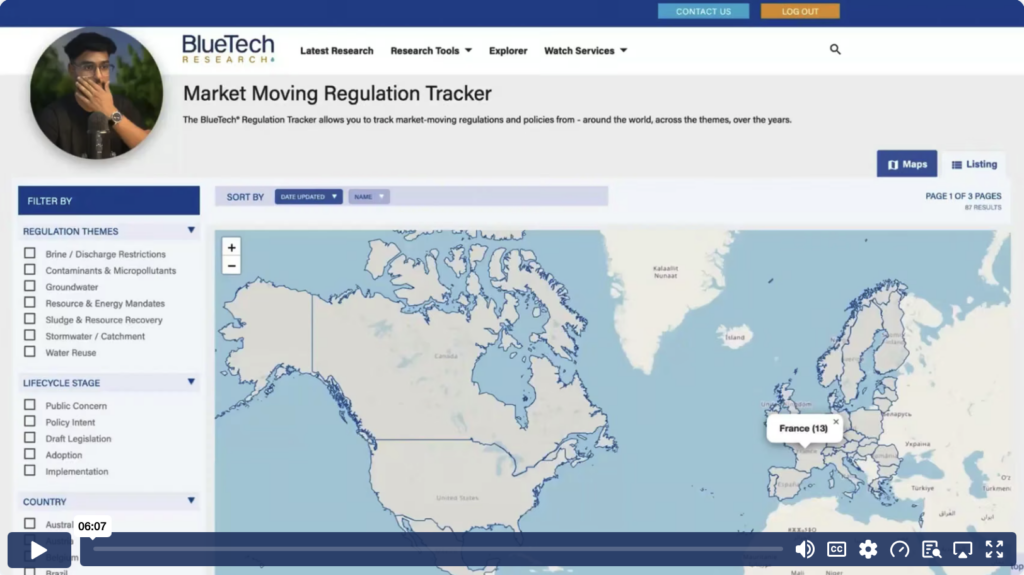
A central theme in the discussion was that regulation is no longer just a compliance overlay. Increasingly, it is the layer where consequences become explicit.
In several jurisdictions, reuse requirements are becoming embedded in planning logic. New industrial facilities are expected to design around recycling thresholds from day one. Retrofitting later is often not viable. This is not efficiency capex, it is defensive capex to protect the right to build.
Elsewhere, contaminant regulation is moving upstream into product eligibility. Restrictions on PFAS in products, for example, shift water risk from an EHS conversation to a commercial one. Reformulation becomes a market access issue, not just a discharge issue.
And in parts of Europe, cost-allocation mechanisms are reframing responsibility. Under evolving wastewater directives, producers may inherit ongoing treatment cost burdens for micropollutants. Water risk becomes an OPEX story, not a hydrology story.
Across these examples, the physical water conditions may not have changed overnight. What changed was the rulebook.
Two sites in the same basin, facing identical stress indicators, can experience entirely different business outcomes depending on regulatory posture, enforcement discretion, and cost allocation.
From knowing to proving
Another shift highlighted in the session is the move from informal abstraction to measurable accountability, particularly around groundwater.
In regions such as India, Mexico, and parts of Australia, groundwater use is moving from “quiet abstraction” to monitored, enforceable regimes. The question for industry shifts from “do we have access?” to “can we maintain this level of access under increasing scrutiny?”
Water risk is becoming less about theoretical exposure and more about demonstrable compliance.
The timing problem
Perhaps the most uncomfortable insight from the discussion was about timing.
Many signals that materially change decisions appear only after strategic flexibility has narrowed. By the time regulation tightens, products are designed, assets are built, and portfolios are fixed.
The real challenge is not mapping stress. It is identifying early signals that alter the decision context. Early enough to matter.
As one framing from the session captured succinctly:
Pressure tells us where to look. Consequence tells us what to do.
Organisations that rely solely on physical indicators may see the pressure but miss the moment when consequence becomes inevitable.
Reframing water risk for decisions
The broader takeaway was not that existing tools are wrong. It is that they are incomplete when used in isolation.
A more resilient approach to water risk assessment considers:
Physical stress and availability
Regulatory trajectory and enforcement discretion
Institutional capacity and permitting logic
Product and portfolio exposure
Cost allocation and liability shifts
Water risk is a layered decision context. The Mastermind format was designed to leave participants with sharper questions rather than easy answers. If the discussion made anything clear, it is this: water risk does not become real when pressure increases. It becomes real when consequence crystallises, and by then, the room for manoeuvre may already be shrinking.